
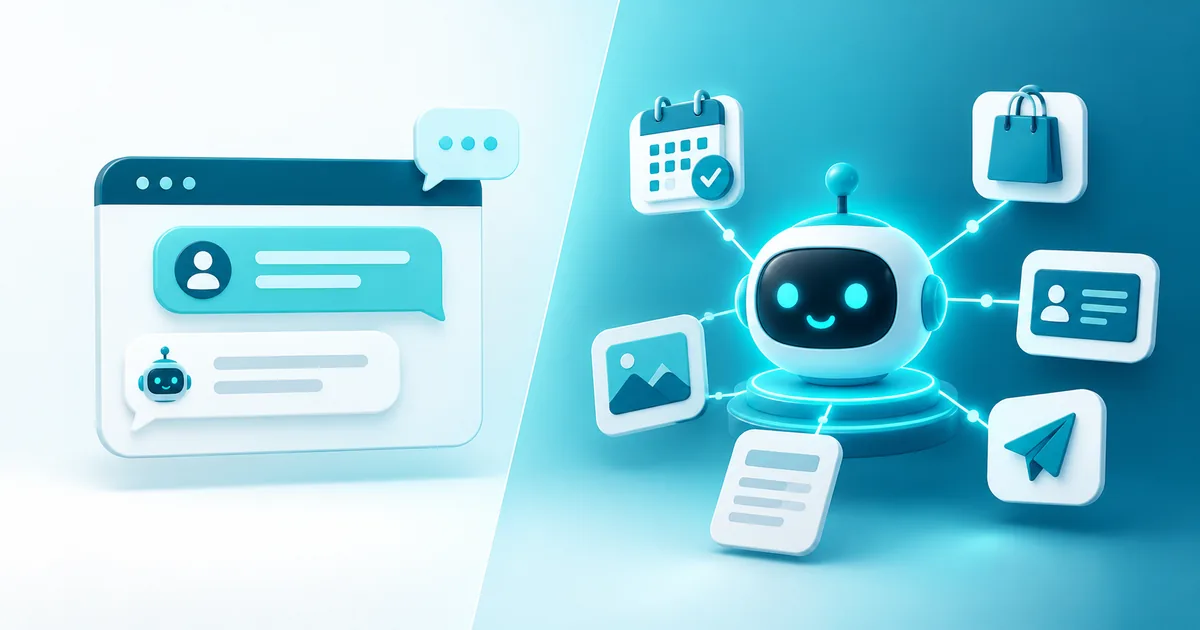
A chatbot holds a conversation; an AI agent holds the conversation and then does something with it, such as booking the appointment, logging the lead or checking the order. Most Muscat businesses do not need a fully autonomous agent on day one. They need a reliable AI chatbot that answers well in Arabic and English, with one or two carefully chosen actions added once the answers can be trusted.
What is the difference between a chatbot and an AI agent?
The word "chatbot" gets used for three quite different things, and vendors are not always clear which one they are selling. Here is the plain version.
| Type | How it works | Good for | Where it breaks |
|---|---|---|---|
| Rule-based bot | Button menus and keyword triggers, written in advance | Very simple, predictable choices | Any question nobody scripted |
| AI chatbot | Understands free text and answers from your approved information | Enquiries, FAQs, lead capture | Anything that needs it to change data in another system |
| AI agent | An AI chatbot that can also use tools: calendar, CRM, store, messaging | Bookings, order lookups, follow-ups | Badly defined permissions or missing guardrails |
Rule-based bots: menus and keywords
This is the bot that greets you with "Press 1 for prices, 2 for location". It does not understand language. It matches a button or a keyword to a pre-written reply, and if your question does not fit, it sends you back to the start.
They are cheap and predictable, which is their whole appeal. They also annoy people. Customers in Muscat rarely write "prices". They write a full sentence, half in Arabic, asking whether the offer from last week's Instagram post is still running. A menu bot cannot do anything with that.
AI chatbots: understanding and answering
An AI chatbot reads what the customer actually wrote, works out what they mean and answers from a knowledge base you approve: services, prices, hours, policies, FAQs. It can ask follow-up questions, collect a name and number, and pass the conversation to a person when it should.
The important limit is that it only talks. It can tell a customer that Thursday afternoon is usually quieter, but it cannot see your diary or put them in it. For a lot of businesses that is perfectly enough, at least at first.
AI agents: taking actions
An agent is an AI chatbot that has been given tools and permission to use them. Instead of "someone will call you to confirm", it checks the calendar, offers two real slots and books the one the customer picks. Instead of "please email us your order number", it looks the order up and tells them it left the warehouse this morning.
That is where the value is, and also where the risk is. A chatbot that gives a slightly clumsy answer is a small problem. An agent that double-books a doctor or cancels the wrong order is a bigger one. So agents need tighter design, narrower permissions and more testing.
What does each option look like for a Muscat business?
A few hypothetical examples, using the kind of businesses we see across the city.
A dental clinic in Al Khuwair
Patients message after hours asking about whitening, braces and whether the clinic takes their insurance. An AI chatbot answers those from approved information and collects details. An agent goes one step further: it checks which dentist is free, books the slot and sends a reminder the day before. Anything clinical, such as "my tooth has been hurting for three days", goes straight to the front desk rather than getting an AI opinion.
A real-estate agency in Al Mouj
Enquiries arrive from property portals, Instagram ads and WhatsApp, often in the evening. A chatbot answers questions about a listing and asks the qualifying questions your agents would: budget, buy or rent, timeline, preferred areas. An agent then books the viewing into the right agent's calendar and records the lead in your CRM. If you are running ads to fill that pipeline, it is worth thinking about the bot as part of your lead generation in Oman rather than a separate gadget.
A restaurant in Muttrah
The questions are repetitive: menu, parking, opening hours during Ramadan, whether you can seat twelve on Saturday night. A chatbot handles nearly all of that. Reservations are where an agent helps, but only if your booking system can be connected. If reservations live in a paper diary, start with the chatbot and have it pass booking requests to staff.
An online store based in Seeb
"Where is my order?" is the question that eats customer-service time. A chatbot can explain delivery times in general. An agent connected to the store can look up the specific order and give a real answer. It can also nudge customers who left a basket behind, which is a reasonable action to automate because nothing breaks if the message is ignored.
How do you stop an AI agent making mistakes?
With guardrails decided before anything is built, not after something goes wrong. The ones we would insist on:
- Answer only from approved information. If it is not in the knowledge base, the bot says so and offers a person. It should never invent a price or a promise.
- Narrow permissions. An agent that books appointments should be able to create bookings, not delete them or edit your price list.
- Confirm before acting. "Shall I book Dr Salma at 4:30 on Tuesday?" before writing anything to the calendar.
- Clear topics for human handover. Complaints, refunds, medical or legal questions and anyone who asks for a person go to your team, with the full chat history attached so the customer does not repeat themselves.
- Someone reading the logs. Especially in the first month, a person should review conversations each week and fix what went wrong.
Handover deserves more thought than it usually gets. Decide who receives it, during which hours, and what the bot tells the customer outside those hours. With a Friday and Saturday weekend, a bot that says "an agent will reply shortly" on Friday afternoon is making a promise nobody will keep.
Does it need to work in Arabic and English?
In Muscat, yes. Customers switch between the two freely, sometimes inside one message, and a bot that handles only one language feels half-built. A well-built assistant writes in Modern Standard Arabic, understands Gulf dialect input and replies in whatever language the customer used. For agents, test the actions in both languages too. A booking flow that works perfectly in English and confuses dates in Arabic is a common slip.
How to start small
- Pick one channel. For most businesses here that is WhatsApp, with the website added later. Our WhatsApp Business API guide covers what the setup involves.
- Launch an AI chatbot first. Load your top questions, set up lead capture and handover, and let it run.
- Read the conversations for a few weeks. You will learn what customers really ask, which is rarely what you expected.
- Add one action. Choose the one that removes the most back-and-forth, usually booking or order lookup, and build guardrails around it.
- Expand from evidence. More actions, more channels, CRM updates, once the earlier steps are reliable.
A first build on one channel typically takes two to four weeks from approved content to launch. Each action you add later is its own small project, scoped and tested separately.
So which one do you actually need?
If your problem is unanswered messages, an AI chatbot solves it. If your problem is the back-and-forth after the answer, such as confirming times, chasing details and checking orders, that is agent territory. Most businesses have the first problem now and the second one later, and building in that order is cheaper and safer than starting with an agent you cannot yet trust.
For more on how these assistants are planned and deployed locally, see our page on AI chatbot development in Oman, or the broader AI chatbots and automation service. If you would like a second opinion on where your business sits, TechVantix is happy to look at your enquiries and tell you honestly whether a chatbot is enough.