
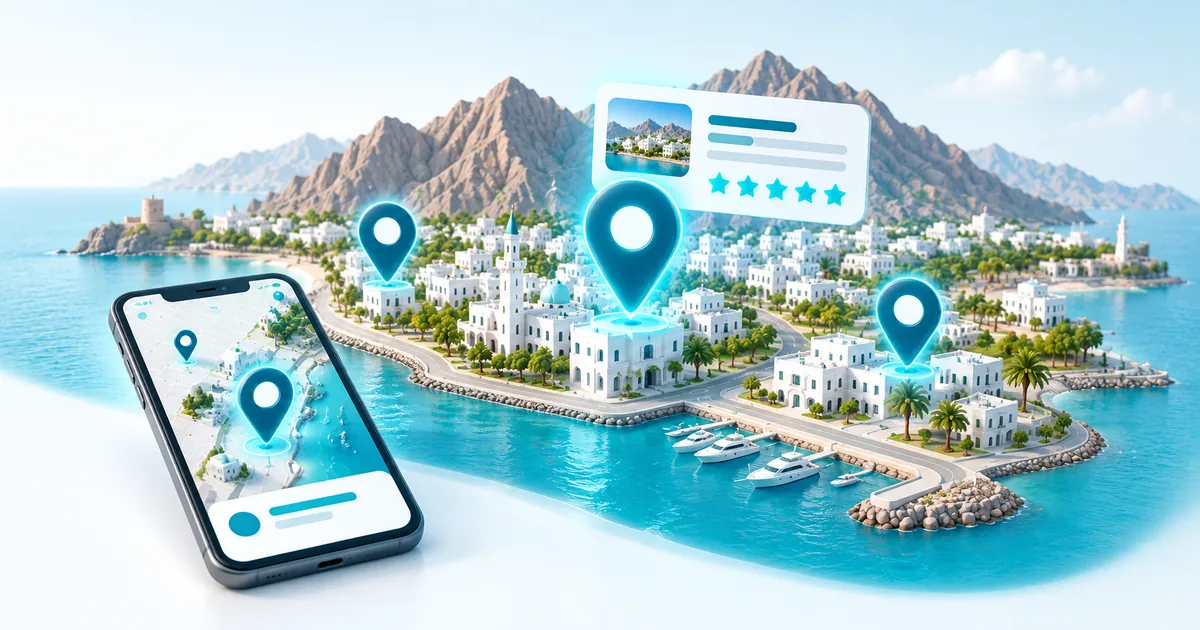
Local SEO in Muscat is the work of getting your business into Google Maps, the local "map pack" and "near me" results when people nearby search for what you sell. The three things that matter most are a complete, verified Google Business Profile, business details that match everywhere they appear online, and a steady flow of genuine reviews. Your website then backs all of that up with pages that clearly say what you do and which areas you serve.
Below is how each piece works in practice, with the mistakes we see most often in Oman.
What is local SEO, and why does it matter in Muscat?
When someone searches "dentist near me" or "car service in Seeb", Google shows a map with a short list of businesses above the normal results. That map pack gets a large share of attention for local searches because it shows the things people want straight away: distance, rating, opening hours, a call button and directions.
Muscat makes this especially relevant. The city is spread out along the coast, traffic between areas is a real consideration, and people prefer a clinic, gym or garage that is close to home or work. Someone living in Al Mouj will rarely drive to Ruwi for a haircut if there is a well-reviewed option nearby. Local SEO is how you become that nearby option in the results.
How do you set up a Google Business Profile properly?
Your Google Business Profile is the single most important local asset you have. It is free, and most of the ones we review in Muscat are half-finished.
- Choose the right primary category. This carries a lot of weight. "Dental clinic" and "Dentist" are different categories and can show in different results. Pick the one that matches what people search, then add a few relevant secondary categories.
- Use your real business name. Adding keywords to the name ("Best AC Repair Muscat Qurum Cheap") breaks Google's guidelines and can get the profile suspended.
- Set accurate hours, including the Friday–Saturday weekend, Ramadan hours and public holidays. Wrong hours lead to annoyed customers and bad reviews.
- Add photos that show the place. The entrance, the parking, the inside. People in Muscat often use photos to work out which building you are in.
- Fill in services and products with plain descriptions, and post updates occasionally so the profile does not look abandoned.
- Answer the Q&A section yourself before someone else does it badly.
If customers come to you, show your address. If you travel to them, such as a cleaning company or mobile mechanic, Google lets you hide the address and set a service area instead. Some businesses, ours included, work entirely online and do not publish an address at all. That is fine, but it means the map pack is not where you will compete, and your website and reviews have to carry more of the load.
Why do consistent business details matter so much?
Google and AI tools cross-check what they find about you. If your name, address, phone number and opening hours read one way on your website, another way on Google, and a third way on an old directory listing from when you were in a different building, that creates doubt about which details are correct.
Pick one exact version of your business name and details, then make every listing match it: your website, Google Business Profile, Facebook, Instagram, Apple Maps, Bing Places and any directories you appear in. The same goes for Arabic. Decide on one Arabic spelling of your business name and use it everywhere, because Arabic names often get transliterated in several different ways.
This is dull work. It is also one of the cheapest fixes in local search, and it gets skipped constantly.
Should you build a page for every area of Muscat?
Probably not, at least not the way it is usually done. A common tactic is to create pages like "Plumber in Qurum", "Plumber in Bausher", "Plumber in Seeb" with the same text and the area name swapped. Google calls these doorway pages and treats them as spam. At best they get ignored. At worst they drag down the rest of the site.
Area pages are worth building only when each one has something genuinely different to say. Say you run a home-maintenance company. A page about Al Mouj could cover the specific issues in those apartment developments and how access works there. A Muttrah page might talk about older buildings and narrow access streets. If you cannot write something real about an area, mention it on your main service page instead and leave it there.
For most businesses with one location, one strong service page per service, with the areas you cover mentioned naturally, beats a dozen thin location pages.
How much do reviews actually matter?
A lot, for two reasons. They influence where you appear in the map pack, and they decide whether people click on you once you do. A business with a handful of reviews from three years ago looks less trustworthy than one with recent, detailed reviews, even if the service is identical.
What works:
- Ask every satisfied customer, right after a good experience. A short WhatsApp message with your direct review link is the easiest route in Oman, since that is where the conversation is already happening.
- Reply to every review, good and bad, in the language it was written in. A calm, helpful reply to a complaint often does more for you than the complaint does harm.
- Never buy reviews or offer discounts in exchange for them. Google removes them, and it is against their policy.
Reviews that mention the service and area naturally ("got my car's AC fixed in Al Khuwair the same day") help more than a row of five-star ratings with no text, though you should never script what customers write.
Do you need local SEO in both Arabic and English?
Yes. Searches in Muscat happen in both languages, often by the same person depending on the moment. Someone might search "paediatric clinic Qurum" in English and later ask their phone in Arabic for the nearest children's clinic. If your profile, website and reviews only exist in English, you are invisible to a large share of those Arabic searches.
This is a core part of any serious bilingual SEO programme in Oman. At a minimum: an Arabic version of your key website pages with correct right-to-left layout, your Arabic business name on your profile where Google allows it, and replies to Arabic reviews in Arabic. Keyword research should be done separately for each language. Direct translations of English keywords often miss how people actually phrase things in Arabic.
How do "near me" and area searches work?
For "near me" searches, Google mostly uses the searcher's location. You cannot optimise for the phrase "near me" itself by stuffing it into your pages. What you can do is make it obvious where you are and what you do, so Google is confident you are a relevant result when someone nearby searches.
Area-named searches like "salon in Madinat Sultan Qaboos" are different. Here Google looks for businesses connected to that area: located there, mentioning it on their site and profile, reviewed by people who mention it. This is where consistent details, a clear service area and naturally written content pay off.
How does local search feed into AI answers?
When someone asks ChatGPT or Google's AI Overview for "a good family dentist in Seeb", the answer is built from many of the same signals local SEO creates: your Google Business Profile, reviews, directory listings and your website content. A business with consistent details and plenty of genuine reviews is far easier for an AI to identify and recommend than one with scattered, conflicting information.
So local SEO is no longer only about the map. It is also the groundwork for showing up in AI answers. If that side interests you, our page on answer engine optimization in Oman goes into how it works.
A practical starting point
If you do nothing else this month, claim and complete your Google Business Profile, check your name and details match across every listing you can find, and start asking happy customers for reviews over WhatsApp. Those three steps fix most of what holds local businesses back in Muscat.
When you want to go further, with bilingual pages, area content that is not spam and proper tracking of calls and direction requests, our SEO services page explains the full approach, and our SEO company in Oman page covers how we handle local search for Muscat businesses specifically.