
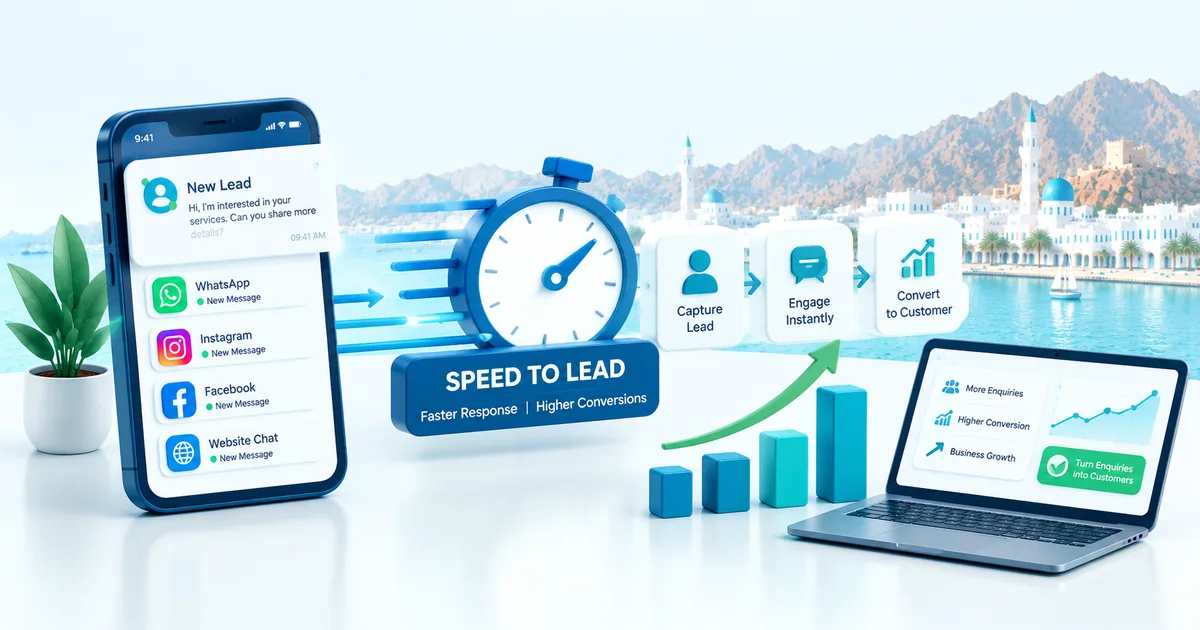
Most leads go cold for one boring reason: nobody answered them quickly enough. The moment someone fills in a form or sends a WhatsApp message is the moment their interest peaks, and every hour you wait gives a competitor the chance to reply first. Fixing it usually needs no extra ad budget, just faster first replies, a page built for one action, a few good qualification questions and follow-up that doesn't rely on anyone's memory.
Why does response time matter so much?
Think about what is true at the exact moment someone enquires. They have the problem in front of them. They have their phone in hand. They have just decided to do something about it. None of those conditions lasts. An hour later they are in a meeting, picking up the kids or cooking dinner, and your business is one of several tabs they meant to come back to.
They also rarely ask only you. Say it's July and the AC fails in a villa in Seeb. The owner messages three maintenance companies in the space of five minutes. The first one to reply with a sensible question and a time slot gets the job, and the other two get a polite "already sorted, thanks" or no answer at all. Their prices and reviews barely came into it.
There is a cost angle too. You have already paid for that click or that boosted post. Answering quickly costs almost nothing extra, while answering slowly quietly throws away money you have already spent. That is why we call response time the most neglected lever in lead generation: it is cheap, entirely in your control, and almost nobody measures it.
How fast is fast enough?
During working hours, minutes rather than hours. Outside working hours, an instant acknowledgement plus a clear promise of when a person will follow up, and then keeping that promise. Remember the Friday–Saturday weekend: an enquiry sent on Thursday evening that waits until Sunday has sat for most of three days.
The easiest way to find out where you stand is to test yourself. Ask a friend to send an enquiry through your website form and another through WhatsApp on a Thursday night, and note when each gets a reply. Most owners are surprised by the answer.
Landing pages built for one action
A slow reply loses leads you've already got. A confusing page loses them before they exist. If you're sending paid traffic to your homepage, with its menu, its six services and its company history, you are asking visitors to find their own way to the point. Many won't.
A landing page that converts does one job:
- One offer, stated in the headline, matching the ad that brought people there.
- One action, whether that's "message us on WhatsApp" or "request a quote", repeated rather than competing with other buttons.
- No main navigation to wander off through.
- Fast loading on a phone over mobile data, because that is how most people will see it.
- Proof near the button: reviews, photos of real work, the areas you cover.
- A line explaining what happens next, such as "we'll reply on WhatsApp within a few minutes during working hours".
If your audience is mixed, build it in both Arabic and English rather than bolting a translation onto the end.
Forms or WhatsApp: which should you use?
Both have a place, and the right choice depends on what you sell.
| WhatsApp button | Web form | |
|---|---|---|
| Effort for the customer | Very low, it's an app they already live in | Higher, especially on mobile |
| Information you receive | Often just "hi, price?" | Structured answers to your questions |
| Speed of conversation | Immediate back-and-forth | Depends entirely on your follow-up |
| Tracking | Needs a pre-filled message or tagged link | Straightforward with analytics |
| Best for | Consumer services, quick decisions | B2B, quotes needing detail |
For most consumer businesses in Muscat, WhatsApp wins because that is where customers already talk to businesses. Forms earn their place when you genuinely need details before you can respond, for example a fit-out company in Madinat Sultan Qaboos that needs the property type and size before quoting. Offering both on the same page is fine, as long as you track each one.
Which qualification questions should you ask?
Enough to tell a serious buyer from a casual browser, and no more. Every extra field costs you leads, so ask only what changes what you do next. Usually that means:
- What they need, in their words or from a short list.
- When they need it.
- Where they are, if you only serve certain areas.
Budget is worth asking in some sectors, but phrase it as ranges and expect some people to skip it. A useful trick is to keep the form itself short and ask the remaining questions in your first reply, where they feel like conversation rather than paperwork.
Instant auto-replies and AI follow-up
Nobody can personally answer every message within minutes at eleven at night. Automation can. There are roughly three levels:
- Acknowledgement. An instant message confirming you received the enquiry and when a person will reply.
- Structured questions. The auto-reply asks your qualification questions, so by the time your team picks it up the context is already there.
- An AI assistant. It answers common questions about services, opening hours and locations, qualifies the lead, books a slot or hands over to a person with a summary.
The third level is where things like AI chatbot development in Oman come in, and it needs guardrails. The bot should hand over to a human the moment a question gets specific, should never invent prices or promises, and should be clear that it's an assistant. Our WhatsApp Business API guide covers the plumbing behind automated WhatsApp replies.
What to do with leads who aren't ready yet
Plenty of enquiries come from people who are early. They're collecting prices for a kitchen renovation next spring, or comparing clinics before they decide. Treating them as dead is a waste, and pushing them for a decision is worse.
Instead, ask when would be a good time to follow up, note it, and then actually do it. Tag these leads separately in whatever system you use. Send something useful in the meantime, perhaps a short guide, a few photos of a similar project, or an answer to the question they asked. Only add people to broadcast messages if they have agreed to it, and keep those messages infrequent and relevant. When they are ready, you want to be the business that stayed helpful, not the one that went quiet or the one that pestered.
Track lead to customer, not just cost per lead
Cost per lead is the number most dashboards show, and on its own it misleads. Picture two campaigns. One produces leads at half the cost of the other, but almost none of them buy. The more expensive campaign produces fewer, better enquiries that turn into customers. Judged on cost per lead, you would cut the wrong one.
The fix is to track every lead through a few simple stages: source, contacted, qualified, quoted, won or lost. A shared spreadsheet is enough to start. Once you can see which channel produces customers, you can calculate what a customer really costs you, which is the number that should drive your budget.
A simple weekly lead review
Thirty minutes at the start of each week, Sunday morning for most businesses here, is enough. Go through the same short list every time:
- How many leads came in, and from which source?
- What was the typical first-response time, and which leads waited longest?
- Did any lead get no reply at all?
- How many were qualified, and how many are stuck at the quote stage?
- What won, what was lost, and why?
- What one thing will you change this week?
The last question matters most. A review that ends without a decision is just reporting.
Where to start this week
Run the Thursday-night test on your own business. Whatever you find, fix the biggest leak first, which is usually the first reply, before spending another rial on ads. Then tidy the landing page, trim your form and start a basic lead-to-customer tracker.
If you'd like help putting the whole system in place, our lead generation service in Oman builds the campaigns, landing pages and instant follow-up together, and the lead generation campaigns page explains how the pieces fit.