
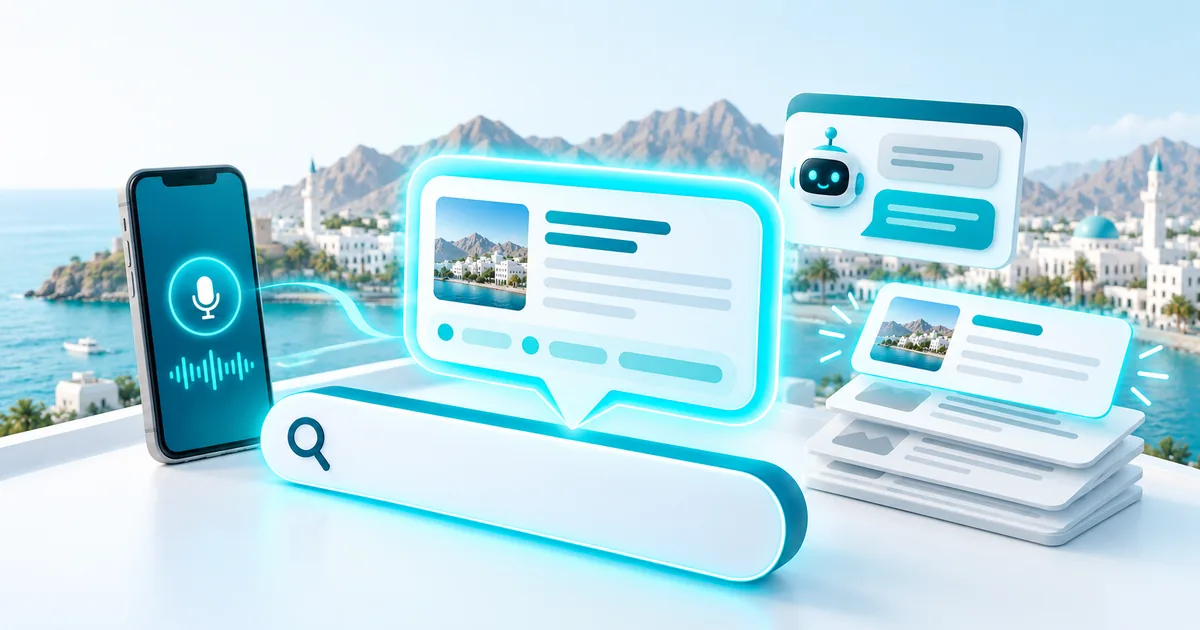
Answer Engine Optimization (AEO) is the work of making your content the answer that search engines and AI assistants give back, rather than one of the links they list underneath. It covers featured snippets, People Also Ask boxes, voice assistants, Google AI Overviews and chat tools like ChatGPT, Gemini and Perplexity. In practice it means writing and structuring pages so a machine can lift a clear, correct answer from them and trust it enough to use it.
That is the short version. The rest of this guide explains what it looks like in practice for a business in Oman, what it can and cannot do, and how to tell a sensible AEO agency from one selling you a story.
What is answer engine optimization, in plain English?
For twenty years, search worked like a library catalogue. You typed a query, Google showed ten results, and you clicked one. Ranking well meant getting on that list, ideally near the top.
Answer engines skip the list. Ask "how often should I service my car's AC in summer" and Google may print the answer in a box at the top of the page. Ask the same thing to your phone and it reads one answer aloud. Ask ChatGPT and it writes a paragraph. In each case, someone's content was used to build that answer. AEO is the discipline of making it yours.
Nothing about this is magic. Answer engines prefer content that is easy to extract: a clear question, a direct answer near the top, then supporting detail. Most business websites are written the opposite way, with a long introduction about the company's passion and values before they get anywhere near a fact.
How is AEO different from SEO and GEO?
The three overlap, and agencies (us included) often sell them together, so it helps to be precise.
- SEO (Search Engine Optimization) gets your pages crawled, indexed and ranked. It is the foundation. If Google cannot find or trust a page, nothing else on this list matters.
- AEO (Answer Engine Optimization) shapes the content on those pages so it can be quoted as a direct answer: snippets, voice results, AI Overviews.
- GEO (Generative Engine Optimization) focuses on how AI models understand your business as an entity: consistent facts across the web, third-party mentions, structured data, crawler access. It is the reason an AI might name your company when someone asks for a recommendation.
A useful way to think about it: SEO earns you a seat, AEO gets your words read out, and GEO gets your name remembered. If you want the GEO side in detail, our earlier guide on getting your business recommended by ChatGPT walks through the checklist. This post stays with the answer side.
Where do answers actually appear?
More places than most business owners realise. The main ones:
- Featured snippets. The boxed answer above the normal Google results, usually a short paragraph, list or table pulled from one page.
- People Also Ask. The expanding list of related questions. Each one opens to a snippet from some website, and each one is a chance to appear.
- Voice assistants. Google Assistant, Siri and Alexa tend to read a single answer. There is no second place in voice.
- Google AI Overviews and AI Mode. AI-written summaries at the top of results, with source links attached.
- ChatGPT, Gemini, Perplexity and Copilot. Chat assistants that pull from their training and, increasingly, from live web retrieval. Perplexity in particular shows its sources openly.
The same well-structured page can feed all of these. You do not need five separate strategies, but you do need to know the formats each one prefers.
What actually changes on your website?
Say you run a physiotherapy clinic in Al Khuwair. Your service page currently opens with "Welcome to our state-of-the-art facility, where patient care comes first." A patient searching "do I need a referral for physiotherapy in Oman" gets nothing useful from that sentence, and neither does Google.
An AEO pass on that page would usually involve:
- Finding the real questions. We pull them from People Also Ask, autocomplete, and, most usefully, from the clinic's own WhatsApp and Instagram messages. Your front desk already knows the top twenty questions by heart.
- Answering first. Each question gets a heading, then a complete answer in roughly 40 to 60 words, then the detail. The answer should still make sense if it is copied out on its own.
- Matching format to the question. "What is" questions want a short paragraph. "How do I" wants numbered steps. "X or Y" often wants a small table.
- Adding schema markup. FAQPage, Service, Organization and LocalBusiness structured data label what each part of the page is. Google now shows FAQ rich results for very few sites, so do not expect the visual dropdowns, but the markup still helps machines read the page correctly.
- Being specific. Vague claims do not get quoted. "Sessions usually last 45 minutes and most patients need between four and eight" is quotable. "We offer flexible treatment plans" is not.
None of this requires rebuilding your site. Most of it is rewriting and restructuring pages you already have.
Does AEO work in Arabic as well as English?
Yes, and in Oman it has to. Customers here switch between languages constantly. The same person might type an English search on a work laptop, then ask their phone a question in Arabic on the drive home. Many people ask AI assistants in Arabic first, especially for anything personal or family-related.
The catch is that Arabic AEO is not translation. People phrase questions differently in Arabic, often in Gulf dialect rather than formal Modern Standard Arabic, and the questions themselves can differ. Good Arabic pages are researched and written for Arabic searchers, with proper right-to-left layout and hreflang tags so Google serves the right version. A machine-translated FAQ will rarely be the answer anyone picks. Arabic is part of what we cover as an AEO agency in Oman, and it is worth asking any provider how they handle it.
What results should you expect, and when?
AEO is one of the faster search disciplines because it mostly works with pages that already exist. If a page already ranks on the first page for a question, restructuring it can win a featured snippet within weeks. Sometimes it takes longer, and sometimes a competitor's answer stays put.
AI assistants are slower and less predictable. Retrieval-based tools like Perplexity can pick up a good page fairly quickly. Mentions inside ChatGPT or Gemini answers depend on how well those models understand your business overall, which is GEO territory and builds over months.
Be ready for one awkward fact: answer features can reduce clicks. If your snippet fully answers the question, some people will not visit. In our experience that trade is still worth it for most businesses, because being the visible answer builds recognition at the exact moment someone is researching, and the people who do click are better informed. But measure leads and enquiries, not just traffic, or the reports will look worse than reality.
How do you choose an AEO agency in Oman?
The field is new, which means plenty of people are selling it without much to show. A few things to check.
Good signs:
- They start by showing you what AI engines currently say about your category in Muscat, before any work begins, so progress can be compared later.
- They talk about your existing pages and your customers' real questions, not a generic content package.
- They can do the work properly in Arabic, not just run English copy through a translator.
- They treat SEO as the base layer and are honest when your site needs technical fixes first.
Red flags:
- Guaranteed AI mentions or guaranteed snippets. Nobody controls what ChatGPT or Google chooses to show. An agency can build the signals those systems rely on, and that is all anyone can honestly promise.
- Reports built on screenshots of a single prompt. AI answers vary between sessions, users and days. A credible agency tests a set of prompts repeatedly and reports patterns.
- Mass-produced AI-written articles. Thin, repetitive content is exactly what answer engines learn to ignore.
- Advice to block or trick crawlers, or to stuff pages with hidden text aimed at AI. Shortcuts like these tend to backfire once the engines catch up.
Where to start
You can make a useful start this week without anyone's help. Write down the ten questions customers ask most often, check whether your website answers each one clearly in the first couple of sentences of a page, and fix the ones that do not. Then search those questions yourself on Google and in ChatGPT, in English and Arabic, and note who currently gets quoted. That gives you a baseline and a fairly honest picture of the gap.
If you would rather have it done properly, including schema, Arabic content and ongoing tracking, our Answer Engine Optimization service covers the method in more detail, and our page for the answer engine optimization agency in Muscat explains how we approach it for Omani businesses specifically. It sits alongside Generative Engine Optimization for the brand-recognition side.